On this page:
- This is some text inside of a div block.
- This is some text inside of a div block.

%20(1).png)
For a long time, Linnworks was a reliable choice for multichannel ecommerce sellers who needed a way to manage inventory, orders, and shipping across multiple marketplaces from one place. But after a series of pricing changes, a shift to quote-based plans, and growing frustrations with how difficult the platform can be to use, a lot of sellers have started looking for Linnworks alternatives that can get the job done without the headaches and the steep price tag.
If you've been thinking about making the switch, or if you're a newer seller evaluating multichannel ecommerce tools for the first time, you've come to the right place. In this guide, we'll walk through 10 Linnworks alternatives worth considering, break down what each one does well (and where it falls short), and cover what to look for when choosing a new platform for multichannel management.
Key Takeaways
Linnworks is a multichannel platform with automation features, real-time inventory sync, and over 100 integrations with marketplaces, shopping carts, and shipping carriers. It was built primarily for high-volume sellers managing large-scale operation with multiple warehouses and fulfillment centers. While it does this reasonably well, a number of recurring issues have pushed sellers to explore alternatives to Linnworks.
Firstly, there's the issue of pricing, a parameter on which Linnworks has become increasingly difficult to evaluate. The platform removed its publicly listed pricing in 2024, switching entirely to a quote-based model that requires sellers to schedule a sales call and divulge details about their business just to get a price estimate. Based on what users and industry sources have shared, plans are estimated to start at around $449 per month, and onboarding fees can range anywhere from $4000 to $12000 depending on the scope of the setup. For small to mid-sized sellers, these prices are prohibitively expensive, especially when there are alternatives available with clear, transparent pricing starting well under $100 per month.
Another reason sellers might search for alternative platforms is the user experience that Linnworks offers. For many sellers, Linnworks itself can be difficult to work with on a day-to-day basis. As a platform designed for enterprises, both the setup process and the everyday experience can often be far more complex than what most sellers need. Its interface can feel cluttered and outdated, and getting things configured often requires a significant time investment. For sellers who simply want a straightforward way to list products on a few selling channels, sync inventory, and manage orders without a lengthy onboarding process, Linnworks starts to look like more hassle than it's worth.
On the customer support side, Linnworks offers community forums, a knowledge base, and a ticketing system, but getting timely help with technical issues doesn't always go smoothly. The platform's mobile app has also drawn criticism for remaining in beta for an extended period and lacking core functionality that sellers expect from a mobile experience.
Finally, when it comes to marketplace coverage, Linnworks' integrations can feel limited compared to newer tools on the market. Sellers who want to list on social commerce channels like TikTok, Instagram, or Facebook, or who are exploring newer marketplaces, may find that Linnworks doesn't support the channels they need.
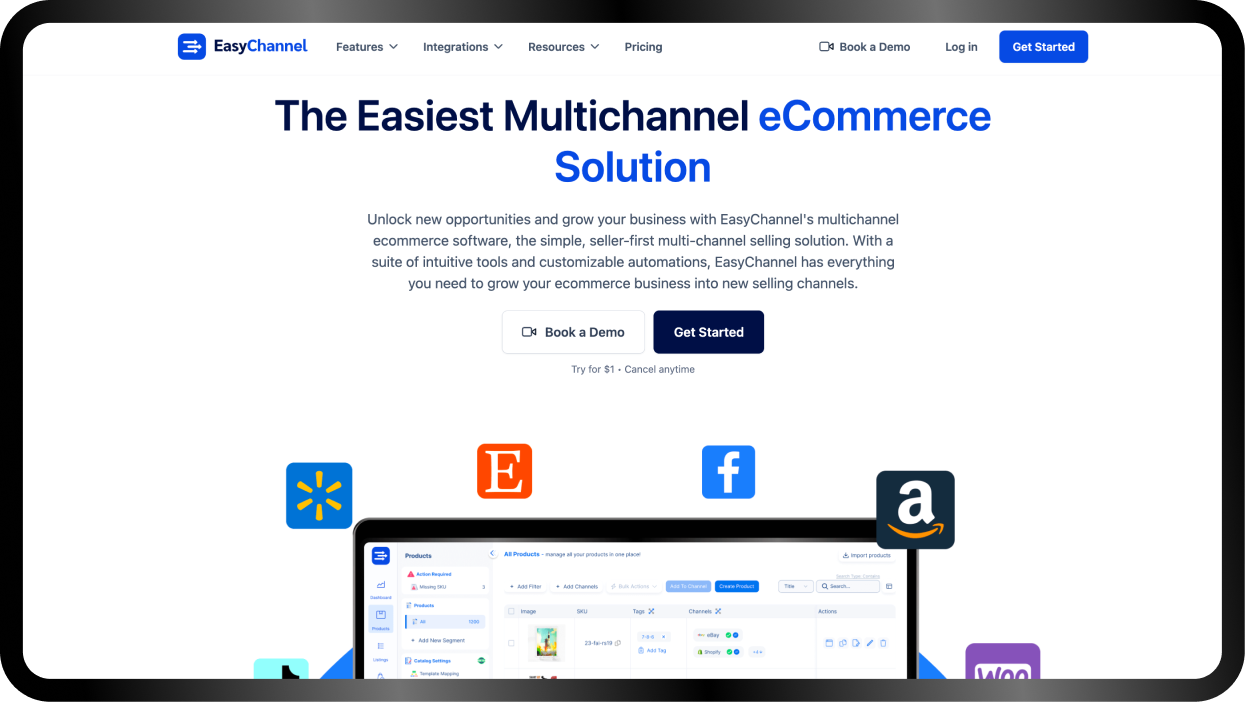
EasyChannel is an AI-powered multichannel listing and selling management tool built for online sellers who want to grow their business across new selling channels without getting bogged down learning a complicated new tool. It integrates with leading marketplaces like Amazon, Walmart, eBay, and Etsy, shopping carts like Shopify, BigCommerce, and WooCommerce and popular social commerce platforms including Instagram, TikTok Shop, and Facebook.
As opposed to Linnworks, which requires significant setup and a degree of technical know-how, EasyChannel is designed to be simple enough that any seller can get started without a technical background. Setting up an account takes minutes, and importing products from an existing selling channel is a simple, one-click process. Once products are imported into the multichannel catalog, sellers can publish them to any connected channel with a click, and tailor them to every channel with AI-powered custom mapping templates.
In addition to simple multichannel listing management, EasyChannel automatically synchronizes inventory across all connected channels, imports all orders into one centralized order management system for easier multichannel order management, and seamlessly integrates with an optional AI-powered ecommerce helpdesk for managing customer communication across platforms. Plus, it supports bundles and kits, cross-channel pricing sync, and CSV imports and exports for everything from stock updates to reporting.
One of the areas where EasyChannel stands apart is its AI ecommerce tools, which are integrated into nearly every feature on the platform. Sellers can use AI to generate SEO-optimized titles, descriptions, and bullet points in one click, translate product data into multiple languages for international markets, auto-map product categories when expanding to new selling channels, and even create listings or products with AI using just a product image, title, URL, or identifier. Plus, its bulk actions tools make it easy to make sweeping edits to listings or products in a matter of seconds, either with AI prompts or custom rules. EasyChannel's robust automations also allow sellers to create custom crosslisting rules, create backend listing segments based on various parameters, and even fully automate fulfillment across channels with integration for Amazon MCF (FBA) and Walmart WFS.
For customer service, AI-powered helpdesk tools allow sellers to generate replies, summarize conversations, and rephrase messages, making it easier to maintain quality customer service at scale.
Pricing for EasyChannel starts at just $39 per month with transparent, tiered plans that grow with your business. Before committing, you can try EasyChannel for 14 days just $1, cancel anytime.
Cin7 is a cloud-based inventory management platform aimed at mid-sized retailers, wholesalers, and manufacturers. It combines inventory tracking, purchasing, order management, and light manufacturing capabilities in one system, with integrations for platforms like Shopify, Amazon, and eBay, accounting software like QuickBooks and Xero, and shipping tools like Shipstation.
Compared to Linnworks, Cin7 offers a wider range of integrations (over 700 versus Linnworks' approximately 100+), built-in manufacturing support with bill of materials (BOM) management, a B2B ecommerce portal, and a point-of-sale (POS) add-on for brick-and-mortar retail. For sellers who need deeper inventory management, supply chain visibility, or native accounting integrations, Cin7 is a much more complete option than Linnworks.
While it can be a powerful tool, Cin7 has a steep learning curve and setup can take a considerable amount of time. Pricing starts at $349 per month for the Standard plan, $599 per month for Pro, and $999 per month for Advanced. Cin7 also charges an hourly rate for onboarding and implementation, and because the platform is so extensive, these costs can add up quickly.
Ultimately, Cin7 works best for businesses that have outgrown simpler tools and need ERP-like functionality, but it's not the most accessible option for sellers just getting into multichannel ecommerce.
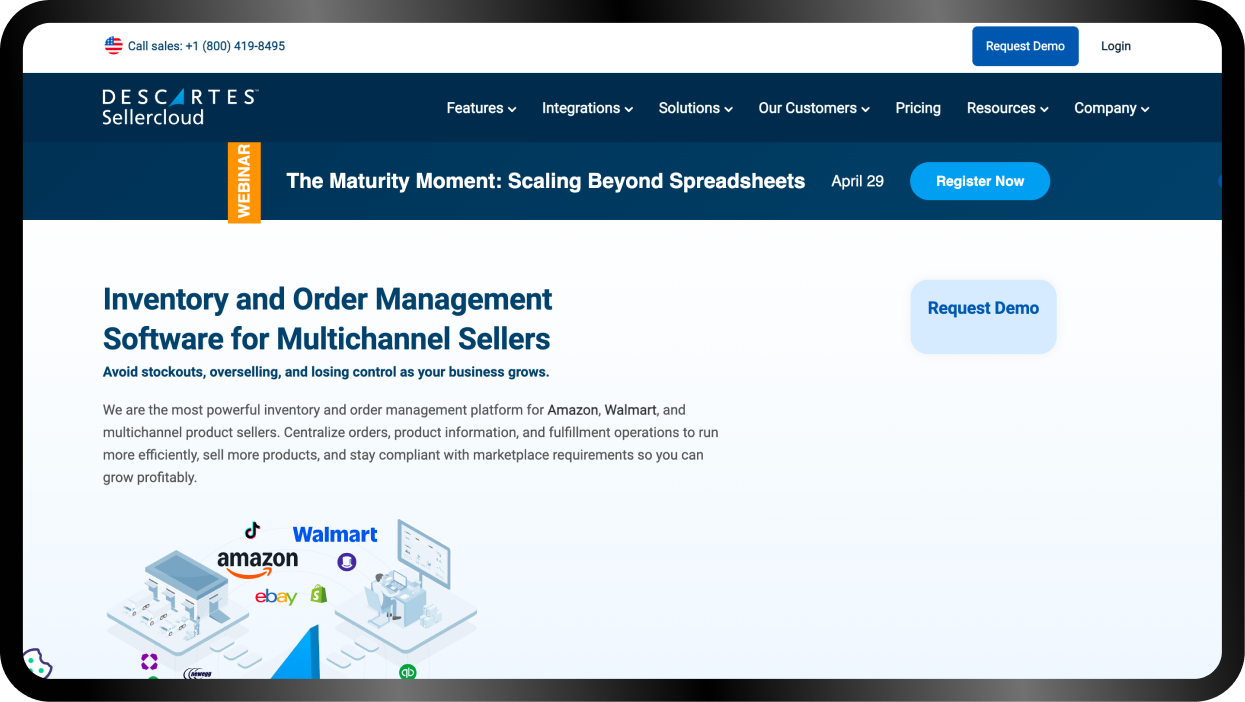
Sellercloud is a multichannel ecommerce platform designed for large-scale operations that need a high level of customization. It offers over 280 integrations for marketplaces, shopping carts, shipping carriers, vendors, and third-party logistics providers.
Relative to Linnworks, Sellercloud provides more reporting options, includes a native warehouse management system, and offers free implementation and onboarding, which stands in contrast to Linnworks' paid implementation and onboarding process.
Pricing is volume-based, with the per-order cost decreasing as order volume increases, and there is a minimum monthly plan which starts at $1100 regardless of usage. That makes it one of the pricier options on this list, and an unrealistic fit for smaller sellers. It's best suited for high-volume ecommerce businesses with demanding workflows that need extensive customization and broad integration coverage.

Sellbrite is a multichannel listing and inventory management tool built for small to mid-sized sellers who want to list products across marketplaces and keep inventory in sync. The tool supports Amazon, eBay, Etsy, Walmart, and shopping carts like Shopify, BigCommerce, and WooCommerce, as well as service integrations such as SKU Vault and ShipEngine. It offers customizable price rules per channel and a listing feature that remembers settings as sellers list and categorize items, but lacks AI features that many sellers expect in the age of AI ecommerce. Since the platform is narrowly focused on listing and inventory sync, sellers who need warehouse management, shipping automation, or any kind of manufacturing support will need to bring in additional tools to cover those gaps, or opt for another tool altogether.
Sellbrite has two plan packages – for multichannel selling and for Shopify stores. For the multichannel package, Sellbrite offers a free plan for up to 30 orders per month, with paid plans starting at $29 per month. For onboarding, Sellbrite charges $99 per hour.
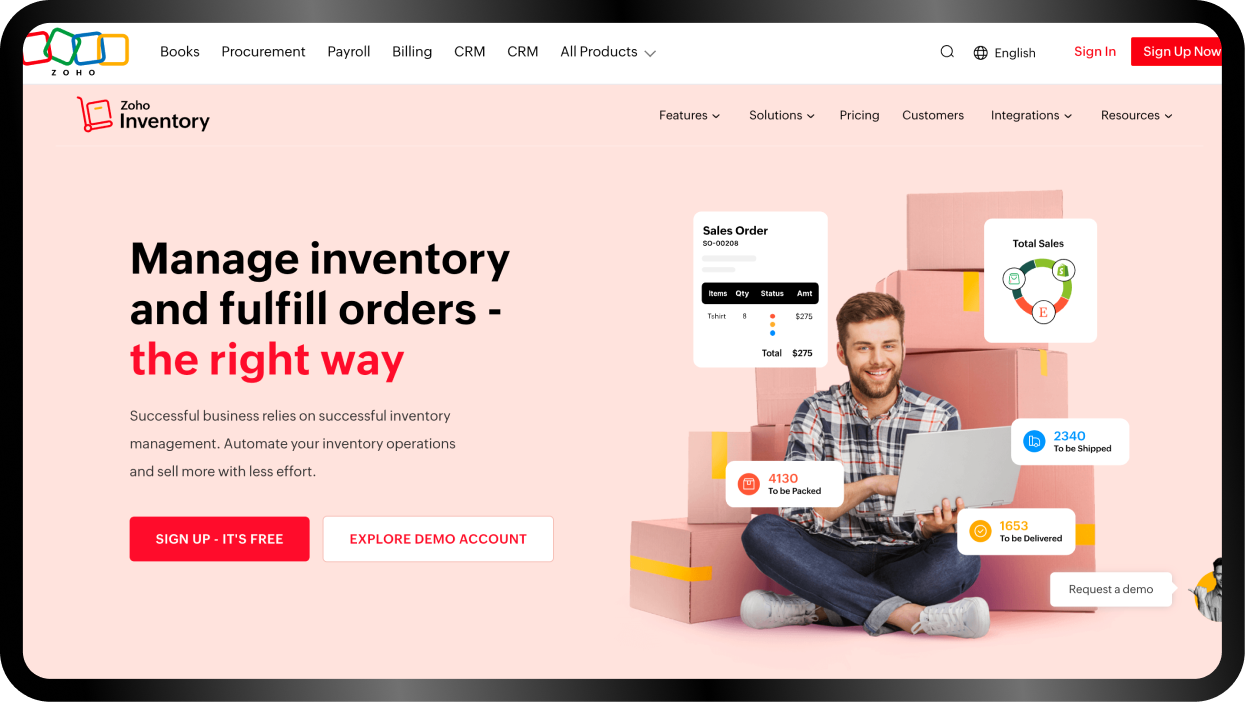
Zoho Inventory is an inventory management tool that fits best for small businesses who already use Zoho products, including Zoho Books for accounting and Zoho CRM.
The platform supports multichannel selling on Amazon, eBay, Etsy, and Shopify, and includes features like shipping label generation, barcode scanning, multi-warehouse tracking, and purchase order management. It's one of the more affordable options available, with a free plan and paid plans starting at $29 per month.
In comparison to other solutions on our list, Zoho Inventory has some drawbacks that are worth noting. The platform doesn't include any AI tools for listing optimization or product data generation, and its marketplace integrations are limited to a handful of channels – notably, it doesn't support Walmart, TikTok Shop, Instagram, or Facebook, which are all major selling channels in today's ecommerce landscape. Additionally, since Zoho Inventory is primarily an inventory management tool rather than a multichannel listing platform, there are no tools for tailoring product data to different selling channels or optimizing listings in bulk. Finally, each plan comes with a monthly order cap, and exceeding it means paying extra.
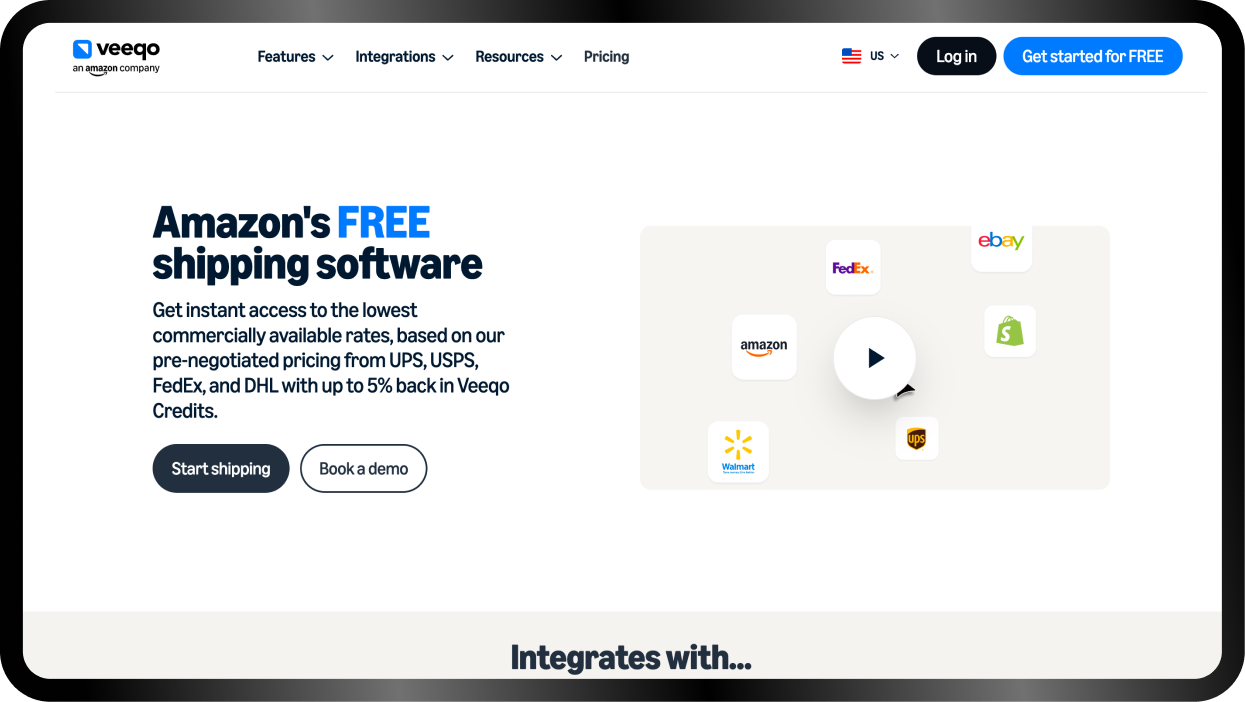
Veeqo is a multichannel shipping and inventory platform that Amazon acquired in 2021 and has since relaunched as a free shipping tool for ecommerce sellers. Optional paid plans for advanced features like inventory sync, digital picking, and multichannel listing are set to launch in April 2026.
The platform's free shipping features come with no limits on order volume or users, and sellers get access to pre-negotiated rates from UPS, USPS, FedEx, and DHL, along with up to 5% back in Veeqo Credits on eligible shipments. Amazon sellers in particular get additional benefits, including protection for on-time delivery rate and A-to-z Guarantee claims when shipping through Veeqo.
Veeqo operates primarily as a shipping and inventory management tool, offering integration for Amazon, eBay, Etsy, Shopify, Walmart, WooCommerce, and other channels. It lacks support for social commerce platforms like TikTok Shop, Instagram, or Facebook, however. Veeqo also doesn't include any AI tools for listing optimization or product data management, and doesn't offer listing features like custom mapping templates or channel-specific product data tailoring. Its complete multichannel management functionality is yet to be launched, but as it stands, Veeqo is a good fit for sellers whose primary need is shipping management, especially if they sell primarily on Amazon.
Veeqo's shipping features are free to use, with sellers paying only for the shipping labels they purchase through the platform. Paid subscription plans for advanced features like inventory sync and multichannel listing are set to launch in April 2026, with pricing based on order volume.
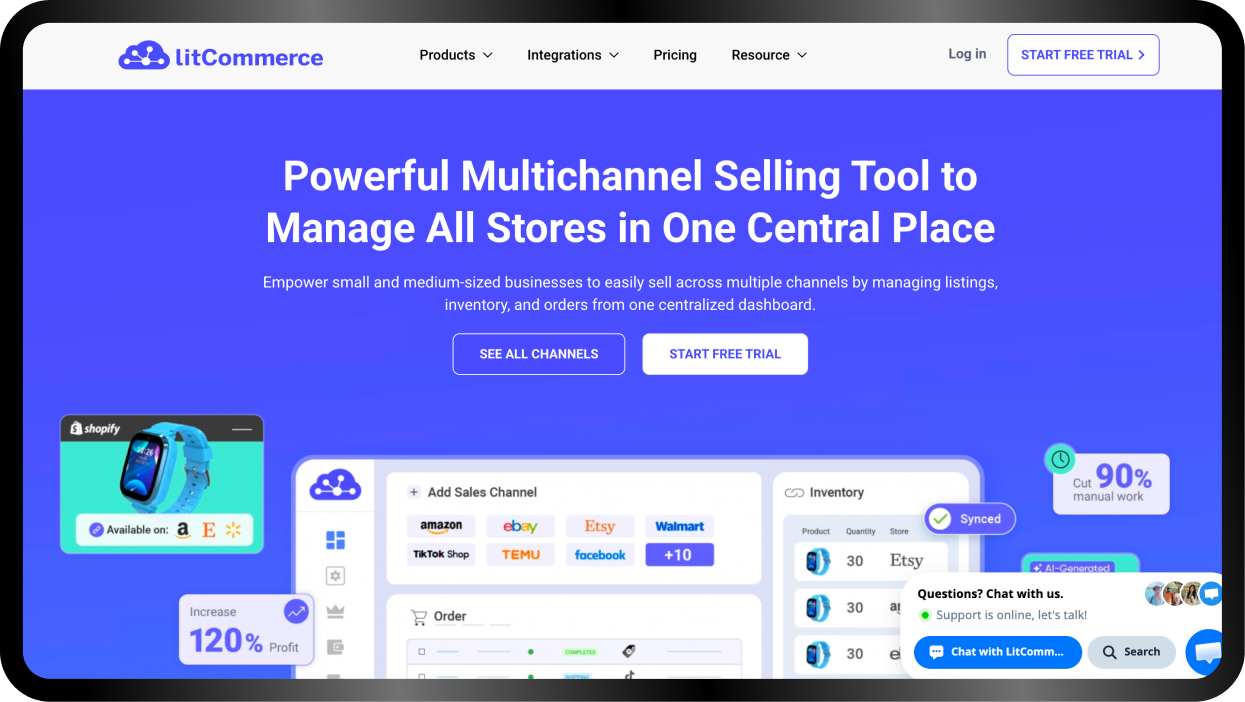
LitCommerce is a multichannel listing tool designed to link ecommerce webstores hosted on Wix, Shopify, BigCommerce, SquareSpace, WooCommerce, or PrestaShop to ecommerce marketplaces, including Amazon, eBay, Etsy, Walmart, and TikTok Shop. It's designed around the idea of using an existing webstore as a central hub, and crosslisting products to marketplaces from there.
The platform includes bulk listing tools, inventory and price syncing across channels, customizable pricing and quantity rules, and centralized order management. Pricing starts at $29 per month for up to 500 listings across up to 3 sales channels, with subscription prices going up with additional channels and listings.
The main drawback of LitCommerce is that it's built around the idea that sellers already have a primary ecommerce store to work from, which means it's not the best fit for sellers who currently sell on marketplaces and don't have their own webstore. It also lacks AI tools for generating or optimizing listing content, doesn't offer an integrated helpdesk option, and doesn't include warehouse management or shipping features.
Ultimately, LitCommerce can be a good fit for certain sellers, namely those who have a webstore hosted on one of their supported platforms, and who do not need more than 2 additional channels or more than 500 listings across their selling accounts. For sellers who foresee more significant growth in their future, LitCommerce might not be the best option to facilitate this growth.

SKULabs is a multichannel inventory and order management platform built for ecommerce sellers who manage their own fulfillment workflows. It combines multichannel inventory syncing with barcode scanning tools for picking, packing, and shipping orders, helping reduce errors and speed up fulfillment for sellers processing a high volume of orders.
The platform integrates with major marketplaces and shopping carts, including Shopify, Wix, Walmart, and TikTok Shop, and offers shipping label generation, carrier rate comparison, bundle and kit tracking, and order routing. Pricing starts at $299 per month and can scale up to $1999 per month for enterprise-level features.
SKULabs makes sense for sellers who need warehouse-level fulfillment tools integrated with multichannel inventory management, but it's overkill (and overpriced) for sellers with simpler multichannel needs.

ChannelEngine is a marketplace integration platform built for mid-market to enterprise brands and retailers that want to sell across a large number of channels, and is geared heavily toward international expansion across global marketplaces. The platform connects backend systems like ERPs, PIMs, and ecommerce platforms to over 1300 marketplaces and sales channels globally, giving it one of the widest integration networks on this list.
Features include automated order processing, real-time inventory sync, dynamic repricing, and advanced product data mapping. ChannelEngine supports both third-party seller (3P) and first-party vendor (1P) selling models, which can be useful for brands that operate in both capacities.
Pricing is quote-based and factors in variables like marketplace GMV, selling regions, number of channels, and SKU count, plus a one-time setup fee. ChannelEngine targets established brands and retailers with at least $1M in annual marketplace GMV, so for smaller sellers, both the pricing and the level of involvement required will be more than they'll need. The platform also doesn't include a built-in helpdesk or customer communication tools, and its initial setup requires a fair amount of technical know-how, which can make onboarding a slower process than with more seller-focused tools.

Listing Mirror is a multichannel listing and inventory management tool that integrates with Amazon, eBay, Walmart, Etsy, and Shopify, though it lacks integration for social commerce channels like Instagram, Facebook, and TikTok Shop. It allows sellers to import listings from one channel and crosslist them to others, with inventory syncing, order routing, and basic repricing features included.
The platform supports bulk listing, channel-specific pricing rules, and integrations with fulfillment services like Amazon MCF. Its plans are available as either listing-only or listing and inventory, with plans for the latter starting at $69 per month for 3 channels and 100 merchant-fulfilled orders per month. Listing Mirror offers a limited free trial (capped at 10 SKUs), and onboarding sessions are available for paid plans.
Where Listing Mirror falls short is in the areas that matter most for sellers looking to actually optimize their presence across channels. The platform doesn't include AI tools for product data generation or listing creation, doesn't offer a helpdesk or customer communication features, and doesn't support social commerce channels like TikTok, Instagram, or Facebook, which are non-negotiable for many sellers in today's ecommerce landscape. Reporting is limited, the interface can feel unintuitive at times, and the platform relies heavily on Amazon as a primary channel, which makes it less flexible for sellers whose primary store lives elsewhere.
Ultimately, Listing Mirror is a functional tool for replicating listings across a few major marketplaces, but it offers sellers little else in terms of true multichannel management.
Choosing the right multichannel management tool comes down to the specific needs of your business, but there are a few things worth evaluating carefully when comparing options.
The first is the scope of features the platform offers, and how they align with your current and future needs. Some sellers only need listing and inventory sync across a handful of channels, while others need full warehouse management, shipping automation, accounting integrations, or manufacturing support. Paying more for a product with features that won't realistically be used is one of the most common mistakes sellers make when switching platforms, so it's worth being honest about what's actually needed before committing to a tool.
The second thing to look at closely is pricing transparency and total cost. Some platforms, like Listing Mirror, advertise low starting prices but tack on extra charges for essential features like inventory management, onboarding, or additional users. Others, like EasyChannel, bundle everything into plans that scale predictably with your business. Understanding the full cost picture before signing up is especially important for sellers migrating away from Linnworks' quote-based pricing model, since one of the main reasons for switching in the first place is often the desire for more straightforward pricing.
Finally, consider how long onboarding takes and how intuitive the platform is to use. Some tools can be up and running within a day, while others require weeks or even months of implementation with dedicated support teams. For sellers who want to get started on new channels quickly, the difference between a one-day setup and a multi-week onboarding process can be significant.
If you're already on Linnworks and looking to move to another platform, be prepared to do some planning. The most important thing is to document your existing workflows before making any changes, including automation rules, shipping logic, warehouse routing, channel-specific pricing adjustments, and any custom configurations you've built up over time in Linnworks.
The next step is to export your product data, inventory levels, and order history. Most alternatives support CSV imports or direct integrations that pull data from existing selling channels, so the migration path will depend on the platform being adopted. With EasyChannel, for example, sellers can import products directly from a connected selling channel or through a CSV upload, making the transition quick and straightforward. EasyChannel also offers an optional onboarding service for sellers who want hands-on help getting everything set up.
Finally, before going live on the new platform, it's a good idea to run a parallel test if possible. Connect one or two selling channels to the new tool and verify that listings, inventory levels, and orders are syncing correctly. This reduces the risk of overselling or missed orders during the transition period.
You made it! and you're now more equipped to sell more online!
Enjoy a reward for your hard work!
Learn more about how EasyChannel works for online sellers.